Levanto
Returning in 2026 to ask what eight clinical programs add up to — and whether the answer is a platform.
Levanto is Baylor Scott & White Health's digital health suite, a collection of condition-specific programs, sold to employers as a benefit for their employees, built on top of the MyBSWH platform. This is the evolution of the specialty care programs that I worked to stand up in 2024. That work was largely about getting individual products off the ground: understanding what each program needed, helping design the patient-facing experience, making sure the pieces shipped.
Coming back in 2026 is a different assignment. The individual products exist now. They work. The question – can they be greater than the sum of their parts?
The work
Leadership from the HCD and Levanto asked me to help answer that question. The suite had grown to eight clinical programs, each built mostly in isolation. Each had its own intake flow, its own data patterns, its own design conventions, its own roadmap. They worked. But they didn't work together, and the gap was becoming a business problem. Levanto's go-to-market pitch to employers is a comprehensive health platform, but the product reality was closer to a bundle of separate things that happened to live disparately in the same app.
My role is to operate one level above the individual product teams. Not designing any single program, but helping design the thing the programs fit inside. In practice that has meant three workstreams running simultaneously.
Understanding the current state
Working with the human-centered design team and a customer research team, we conducted a structured assessment of the current state: mapping end-to-end patient journeys across programs, auditing the design system for fragmentation, and running stakeholder interviews with product leaders to understand where internal alignment held and where it broke down. What we found was a team that was motivated and technically capable, but working around a set of foundational questions about platform identity, about the operating model, about what "unified" actually means at the product level. That hadn't been formally answered yet. Surfacing that clearly, in a form leadership could act on, was its own deliverable.
Finding the foundation
I facilitated a series of cross-product working sessions with the Levanto product leads, structured around the patient journey rather than individual programs. The goal was to identify what I started calling shared elements; the systems, data models, and experience components that could serve all eight programs simultaneously, rather than being rebuilt eight times. The sessions produced a clearer picture of where the real architectural leverage points were, and gave the product leads a shared vocabulary they hadn't had before.
It also uncovered fundamental assumptions that had been made by various leaders in lieu of clear directives. This collaborative effort helped to crystallize those. Are these assumptions we feel comfortable moving forward with? Or are the key questions that need direct input from the C-suite? It became clear how much more important it was that the team had a shared vision and understanding of working assumptions than having out-right clear direction on every little thing.
Framing a path forward
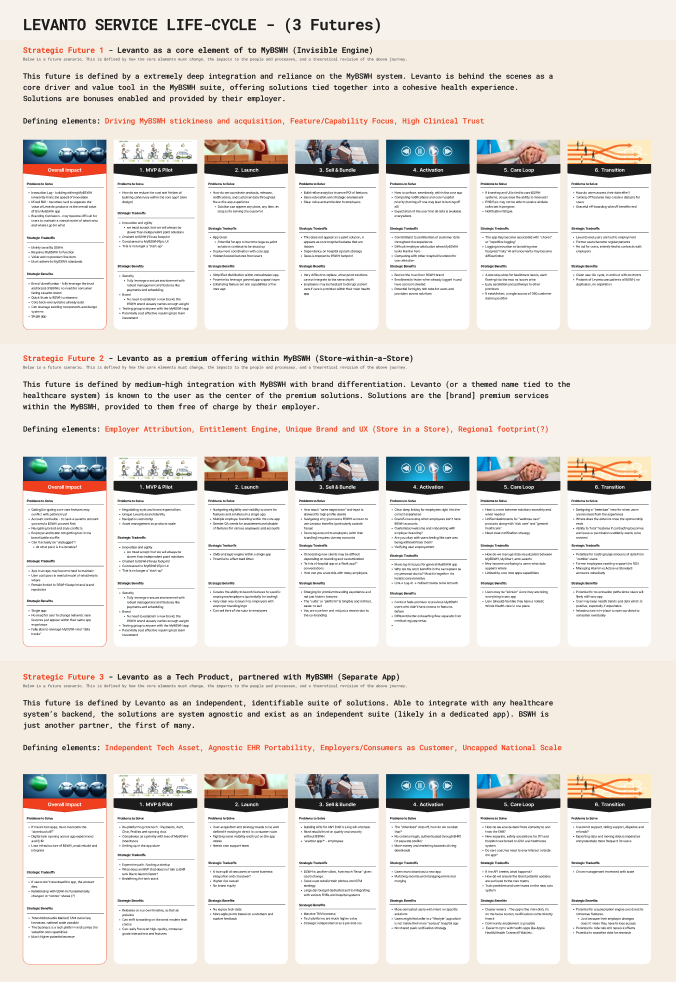
The third workstream is the readout itself, a strategic presentation to senior BSWH leadership synthesizing the diagnostic findings, framing three possible directions for how Levanto could evolve structurally, and recommending a path forward. That work is still in-flight as of this writing.
What this has asked of me
What this engagement has asked of me that the earlier Levanto chapter didn't is a particular kind of restraint. In 2024, progress was visible with screens, flows, research outputs, something you could point to. This work produces documents, frameworks, and questions. It's the kind of strategy work where you sometimes just have to grind it out with a room full of the right people until you hit a breakthrough.
The artifact is a room full of people looking at the same thing the same way.
It is harder to hold and harder to show.
It's also required comfort operating in ambiguity that I didn't fully have to develop before. The strategy wasn't defined when I arrived, to an actionable extent. In some ways it still isn't, but the tone of the team has changed. They understand the mission. They talk about the problems with shared language. The vision their VP has been trying to convey to them is finally clicking. I think they just needed the time in the room.
My job has been to move them forward, not by substituting my judgment for the client's, but by creating the conditions for the right decisions to get made by the right people. I think this is one of the hardest skills in service design to develop, and one I'm still refining.
The work continues.