Standing Up Specialty Care
Four products, one year, and the design organization that grew up building them.
In January 2024, Baylor Scott & White Health's Customer Solutions organization had a problem that most design orgs quietly share: they knew what they needed to build, but not quite how to build it at the level of rigor and pace the business required. Four new digital enrolled programs (Back and Neck Care, Headache Care, Postpartum Care, and Likemind) were in various stages of concept, with siloed product teams working independently and a design organization without the bandwidth or operating model to unify them. They had a product strategy; they did not have products.
Slalom brought in an expert team of six combo product and service designers to help. The mandate was: design four programs and get them into the MyBSWHealth app in time for a June 2024 launch. The larger opportunity, which became apparent quickly, was organizational. We weren't just there to ship screens; we were there to help a growing design team figure out how to work.
The work
Each of the four enrolled programs followed the same basic structure: a condition-specific experience inside the MyBSWHealth app, combining symptom tracking, provider communication, educational content, and a dedicated care coordinator. The execution required building out service blueprints, patient journeys, personas, and high-fidelity product design for each program, from scratch, in parallel, on an aggressive timeline. We could not afford a dev tax of uncoordinated building due to limited resources. We could not afford a design tax of multiple components and user flows accomplishing the same job in different ways. We would have to be smart, have governance, and develop repeatable best practices for the growing org.
I led the Postpartum Care program from discovery through launch and the Headache Care program post-launch. Both started with the same foundational questions: who is this patient, what does she actually need at this moment, and what does the backstage operation have to do for that to happen at all? The answers looked different for each.
Postpartum Care
Postpartum Care was built around a core insight that came out of patient research early in the engagement: the healthcare system effectively abandons new mothers at discharge.
My wife and I had just had our first child and also experienced the surreal moment, having been awakened by nurses, doctors, visitors, every hour on the hour post-birth, when you finally take your new baby home, and suddenly you're alone.
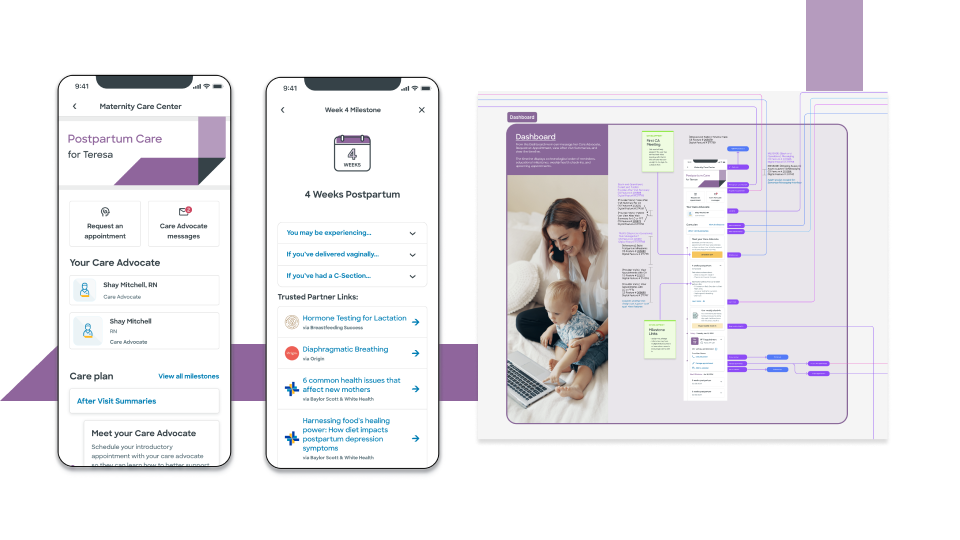
The focus shifts entirely to the infant, and the mother, who is recovering, hormonally destabilized, and often isolated, gets a six-week checkup and not much else. The program was designed to fill that gap: a care advocate assigned at enrollment, weekly check-ins timed to the stages of postpartum recovery, just-in-time educational content, and direct connections to specialists like lactation consultants and pelvic floor therapists.
The design work spanned the full service: enrollment flow, the app experience, the care advocate interface, the communication plan across email, text, and in-app notifications.
Headache Care
Headache Care addressed a different failure mode: the traditional care path for chronic headache and migraine patients is slow, expensive, and rarely personalized. Long waits for neurology appointments, no tracking between visits, treatment plans that don't adapt.
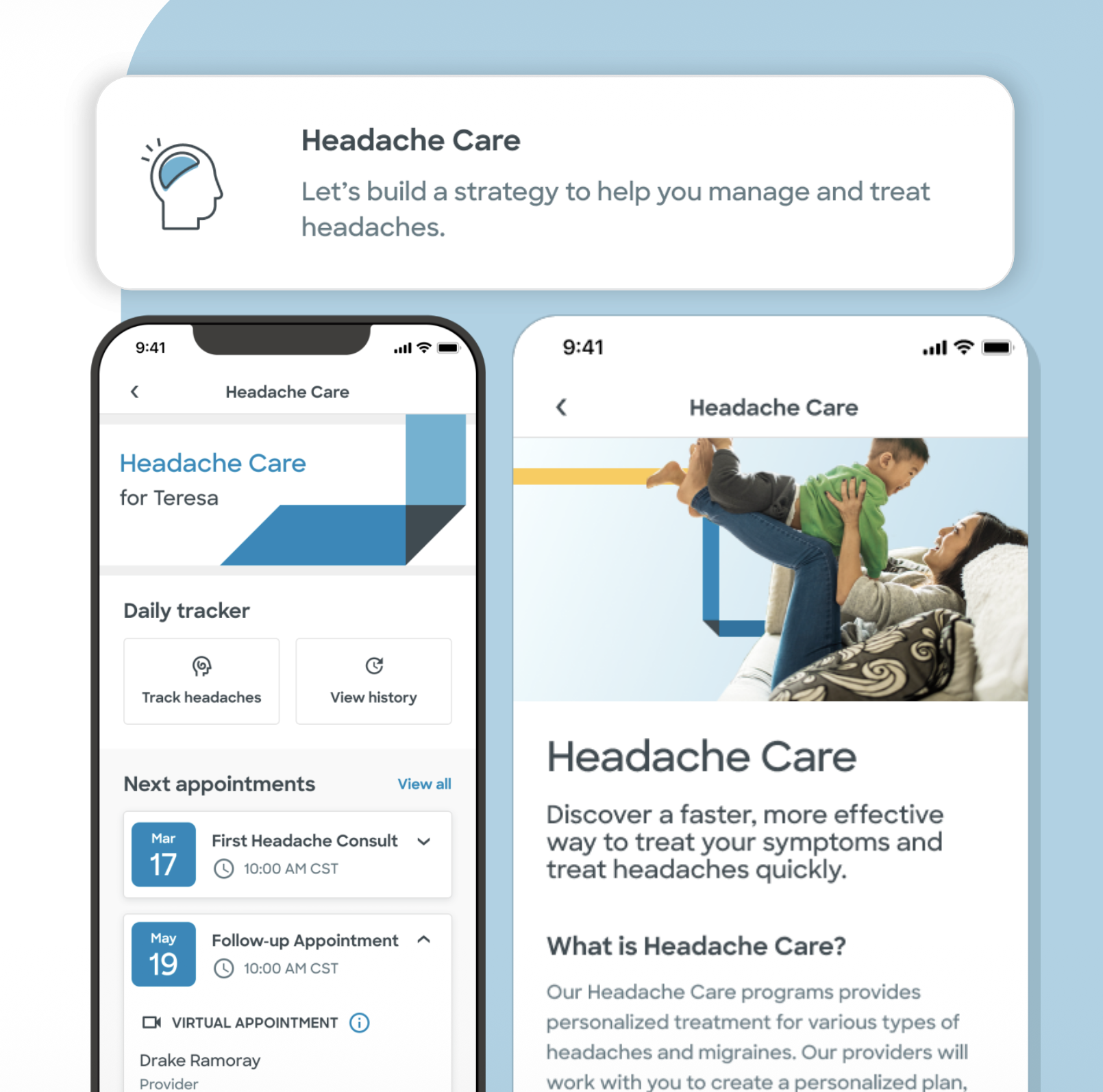
Migraine care typically is like turning many variable knobs, trying to find the perfect combination for you to get relief. The enrolled program offered a simple entry point, a brief questionnaire leading to a personalized care plan, with async messaging, symptom tracking, and virtual appointments built in. Patients could titrate and try different combos more quickly with easy access to a provider, which means quicker relief.
My role was service design and product lead: defining the continually developing patient journey, the provider workflow, the blueprint, and exploring opportunities to drive engagement in the platform.
Org maturity
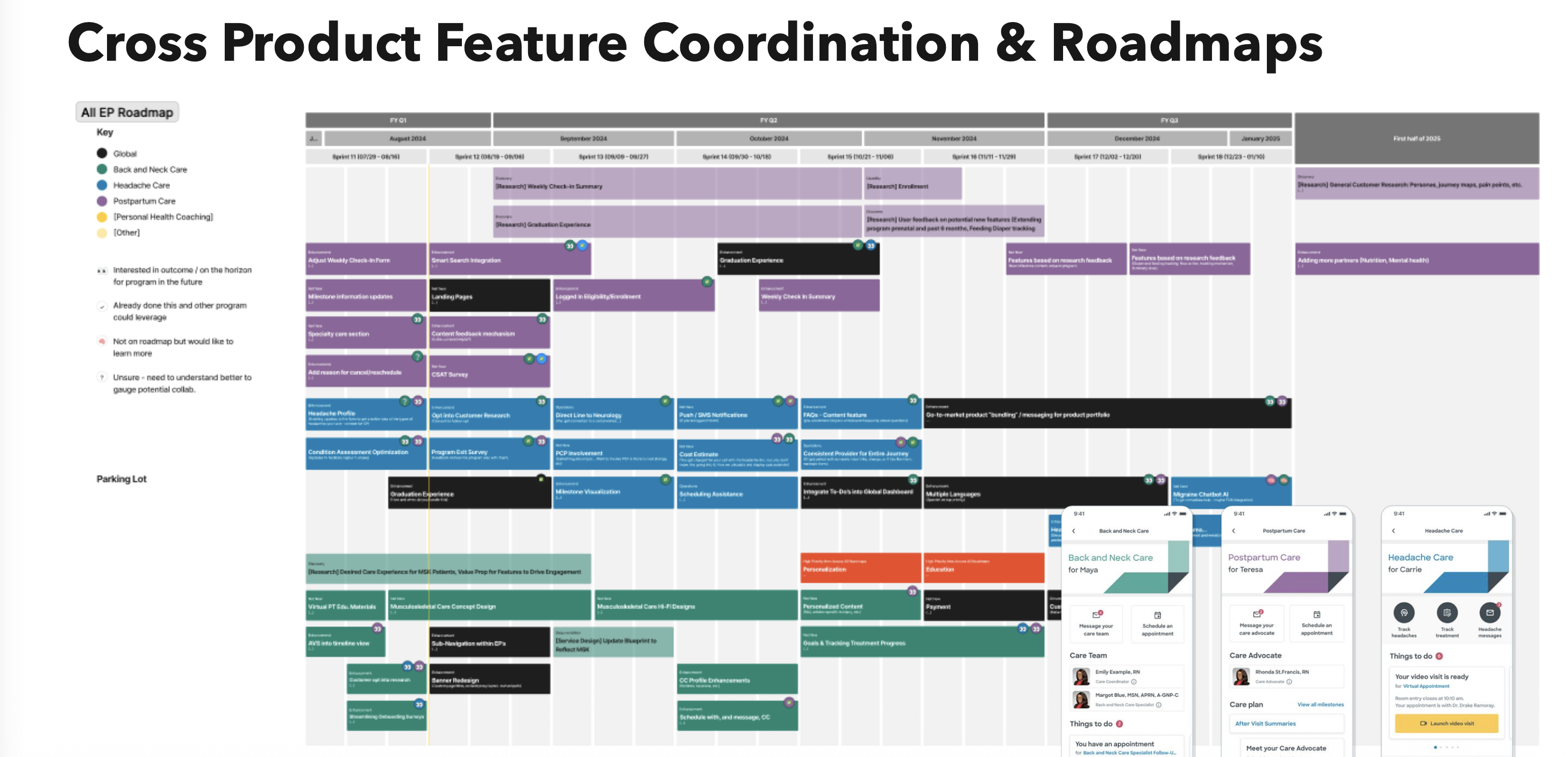
While the individual product work was happening, something else was running in parallel. The BSWH design organization was growing rapidly, and the six programs across the broader Levanto platform were being built in isolation. Different conventions, different component approaches, different design system interpretations. The team was talented and motivated, but the coordination overhead was compounding.
Part of what the Slalom team brought, and what I contributed to directly, was a set of shared frameworks that cut across programs: a unified design language, clearer communication channels between product teams, and a basic operating model for how design decisions got made and shared. None of this was glamorous work. It was the kind of facilitation and alignment that doesn't produce a single deliverable but changes how a team functions.
By June 2024, BSWH launched v8 of the MyBSWHealth app, with three enrolled programs live and a fourth in progress. The Slalom team had shipped on time, the design organization had a clearer operating model than it started with, and the account had grown from a targeted engagement to a multi-year relationship that now spans dozens of workstreams across the health system.
Outcomes
The numbers from the first year hold up well. Back and Neck Care reached 1,024 quarterly enrollments with a 79% CSAT score. Postpartum Care enrolled 469 patients quarterly with 82% CSAT. Headache Care, which was still in earlier rollout, showed 118 quarterly enrollments with an initial 100% CSAT score. Likemind, the behavioral health program, enrolled 233 patients quarterly with 94% CSAT.
Bringing it all together: four programs launched, 200-plus research participants interviewed across the engagement, 7,500-plus survey responses analyzed, and a roughly 3x return on Slalom's investment as measured by the 2024 Customer Survey.
More has happened in her care than in the previous 25 years of trying to get help. Back and Neck Care team member
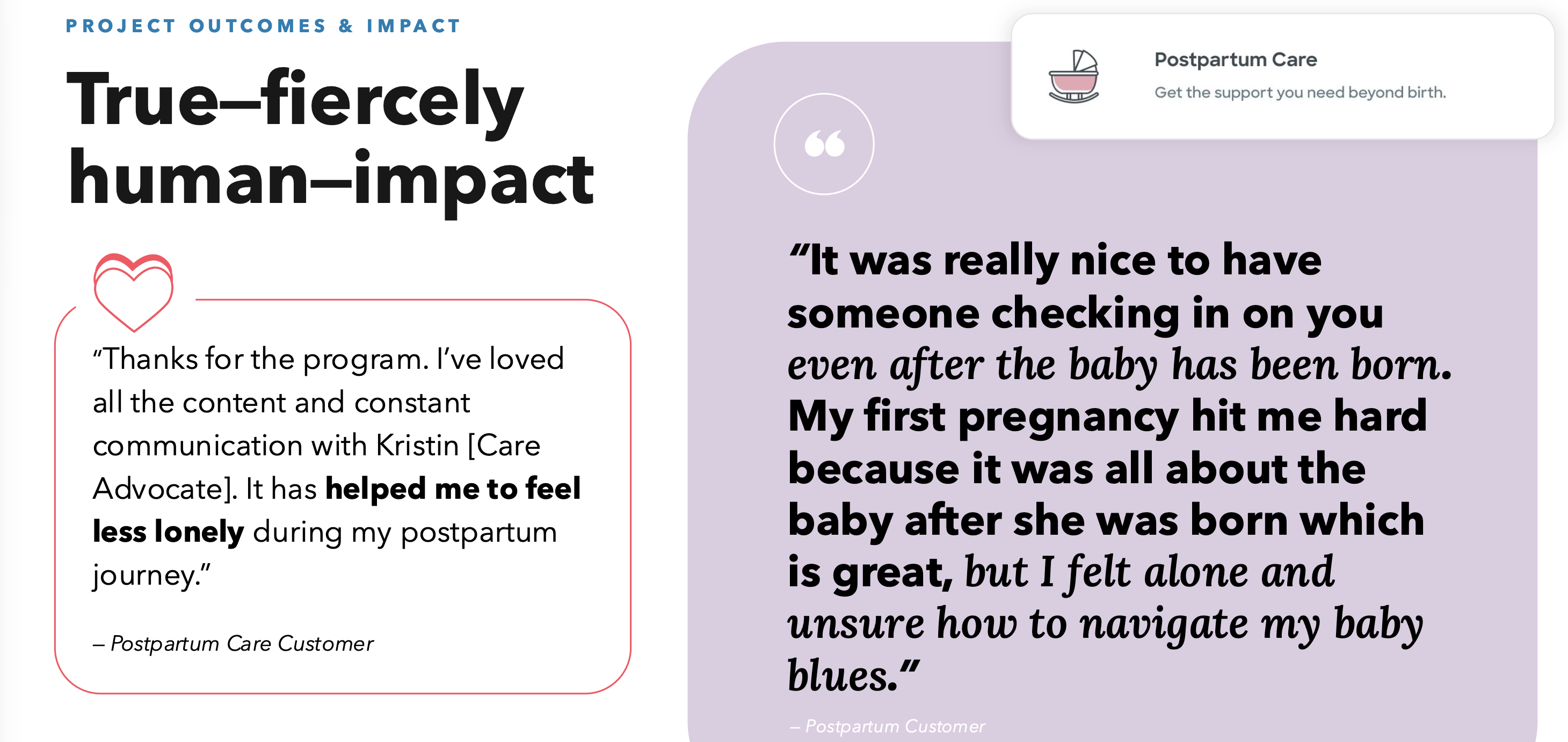
What speaks better than any metric is the patients. One of our operations leads in the Back and Neck Care program told us about a patient who, after a short time enrolled, said the above in tears. That's the thing you're trying to design toward. The numbers confirm the programs worked. Moments like that are why the work matters.
The Specialty Care engagement ended for me in January 2025. The programs were live, the design org was more mature than it had been twelve months earlier, and the account had grown well past its original scope. I came back to BSWH shortly after in March, this time on a different side of the house; the Journeys organization, working on heart failure, caretaker research, and hospital wayfinding. The problems were different. The approach was the same: understand the system, find where it breaks for people, and build the thing that fixes it.